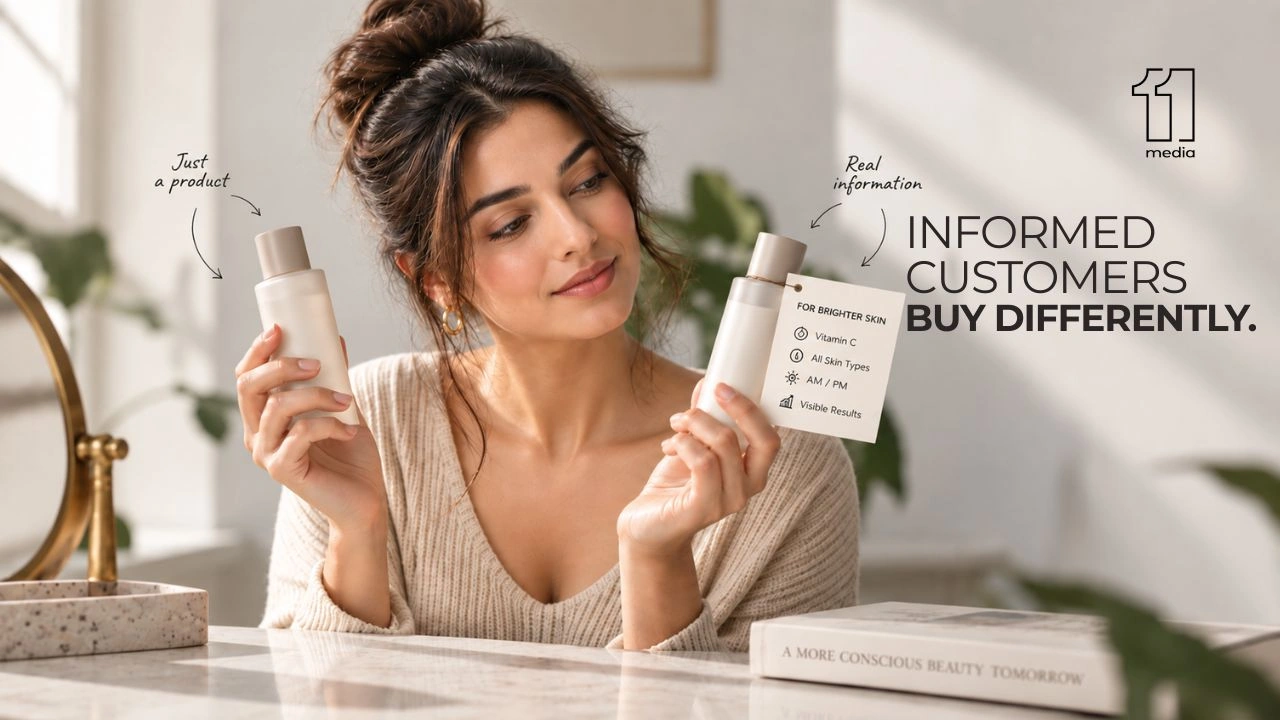
Educational content is content that helps customers learn something useful about beauty, skincare, haircare, makeup, ingredients, routines or product usage.
It can include:
-
Skincare and haircare guides
-
Ingredient explainers
-
Product tutorials
-
How-to videos
-
Beauty routines
-
FAQs
-
Before-and-after explanations
-
Product comparisons
-
Common mistakes
-
Expert tips
-
Product usage guides
-
Blog articles
-
Reels and short-form videos
-
Social media carousels
For example, instead of simply posting:
“Try our new moisturiser.”
A beauty brand could create:
“How to Choose the Right Moisturiser for Your Skin Type”
The second approach gives the audience something useful even before they decide to buy.
1. Beauty Customers Have Questions Before They Buy
Beauty products are personal.
A customer may not know whether a particular serum is suitable for their skin type. Someone buying a haircare product may wonder how frequently they should use it. Another customer may be confused about the difference between two similar ingredients.
These questions create opportunities for educational content.
For example:
-
What does hyaluronic acid do?
-
How often should you use a face serum?
-
What is the difference between a cleanser and a face wash?
-
How do you layer skincare products?
-
How should you choose a shampoo?
-
What is the difference between matte and dewy makeup?
-
Can you use two active ingredients together?
When a beauty brand consistently answers relevant questions, it becomes more useful to its audience.
And useful brands are easier to remember than brands that only appear when they want to sell something.
2. Educational Content Builds Trust
Trust is particularly important in the beauty industry.
Customers are putting products on their skin, hair or body. They want confidence that they understand what they are purchasing.
Educational content gives brands an opportunity to demonstrate knowledge without constantly making promotional claims.
For example, a skincare brand can explain:
“What does Vitamin C do in a skincare routine?”
A haircare brand can explain:
“How often should you wash your hair?”
A makeup brand can explain:
“How to choose the right foundation finish.”
The content doesn’t have to push the product in every sentence.
Sometimes, simply helping the customer understand the problem creates more trust than another sales message.
3. Product Education Can Make Your Products Easier to Understand
One common problem with beauty marketing is that product descriptions can become too technical or too promotional.
Words such as advanced formula, powerful blend and next-generation beauty may sound impressive, but customers still need to know:
What does this product actually do?
Educational content can bridge that gap.
Suppose a beauty brand sells a serum containing several ingredients.
Instead of only listing the ingredients, the brand could explain:
-
What each ingredient is
-
What role it plays
-
How the product should be used
-
When it should be applied
-
Which part of a routine it fits into
-
What the customer should know before using it
This makes the product easier to understand and can help customers make more informed purchasing decisions.
4. Educational Content Gives Social Media More Purpose
Beauty brands often rely heavily on Instagram and other social platforms.
But social media can quickly become repetitive when every post follows the same pattern:
Product → Product → Offer → Product → Offer
Educational content creates variety.
For example, a beauty brand could use a weekly content mix:
Monday: Ingredient education
Tuesday: Product demonstration
Wednesday: Beauty tip
Thursday: Customer question
Friday: Product feature
Saturday: Tutorial or routine
Sunday: FAQ
The exact schedule doesn’t matter as much as the principle.
Your audience should not feel that every post is trying to sell them something.
5. Tutorials Show Customers How to Use the Product
Sometimes customers don’t need more information about what a product is.
They need to know how to use it.
This is where tutorials become particularly valuable.
A beauty brand could create content such as:
-
How to apply a face serum
-
How to build a simple skincare routine
-
How to use a hair mask
-
How to apply liquid foundation
-
How to style hair using a particular product
-
How much product to use
-
When to use a particular product in a routine
Video is especially useful for these topics because customers can see the application process rather than simply reading about it.
And one tutorial can often be repurposed into a Reel, YouTube Short, carousel, blog section and FAQ.
6. Educational Content Can Help With Search Visibility
Customers don’t only search for beauty brands by name.
They search questions.
For example:
“How to layer skincare products?”
“What is the difference between serum and moisturiser?”
“How to choose shampoo for dry hair?”
These searches create opportunities for beauty brands to publish useful content around real customer questions.
This is where SEO, AEO and GEO can work together.
SEO
Helps your content become discoverable through traditional search.
AEO
Helps structure content around questions and direct answers that answer-focused search experiences can understand.
GEO
Focuses on making your brand and information easier to understand and surface within generative search experiences.
The important point is that none of these strategies should turn educational content into a collection of keywords.
Start with the customer’s question. Then create the best answer.
7. FAQs Can Become a Powerful Content Source
Beauty brands don’t need to guess what their audience wants to learn.
Their customers are already asking questions.
Look at:
-
Customer DMs
-
Comments
-
Product reviews
-
Sales team questions
-
Customer support conversations
-
Search queries
-
Questions asked in stores
-
Questions asked by retailers
These questions can become content topics.
For example:
Customer question:
“Can I use this serum every day?”
Content:
“How Often Should You Use a Face Serum?”
Another customer asks:
“What is the difference between these two products?”
That can become:
“Product A vs Product B: Which One Is Right for You?”
This approach makes content more relevant because it comes from actual customer needs.
8. Educational Content Can Support the Entire Buying Journey
Not every customer is ready to buy immediately.
Some are discovering a problem.
Others are researching solutions.
Some are comparing products.
Others are ready to purchase.
Educational content can support different stages.
Awareness
“Why Does Skin Feel Dry During Winter?”
Research
“What Ingredients Help Support Hydrated Skin?”
Consideration
“How to Choose a Moisturiser for Your Skin Type”
Product Evaluation
“What Makes Our Moisturiser Different?”
Post-Purchase
“How to Get the Most From Your New Skincare Routine”
This is much more useful than creating content only for people who are already ready to purchase.
9. Educational Content Helps Beauty Brands Stand Out
Beauty is a highly visual industry.
That is both an advantage and a challenge.
Beautiful photography can attract attention, but many brands can produce beautiful photography.
Education gives a brand another way to differentiate itself.
Two brands may both sell skincare products.
One mainly publishes:
“New launch. Shop now.”
The other publishes:
“What Does Your Skin Barrier Actually Do?”
“5 Common Mistakes in a Skincare Routine”
“How to Read a Skincare Ingredient List”
The second brand is creating a reason for people to follow the account even when they aren’t buying anything.
That can create a stronger relationship between content and brand.
10. Educational Content Can Be Repurposed
One strong educational topic can become multiple pieces of content.
For example, a blog titled:
“How to Build a Simple Skincare Routine”
could become:
This makes educational content more efficient.
Instead of constantly searching for completely new ideas, brands can take one useful topic and adapt it to different platforms.