1. Brand Foundation
Before defining colours and fonts, explain what your brand stands for.
Include:
-
Brand mission and vision
-
Core values
-
Brand positioning
-
Target audience
-
Brand personality
-
Unique value proposition
-
Brand promise
These details help everyone understand the thinking behind your brand identity and make more consistent creative decisions.
2. Logo Usage Guidelines
Your logo is one of the most recognisable parts of your brand identity. Your guidelines should explain exactly how it can be used.
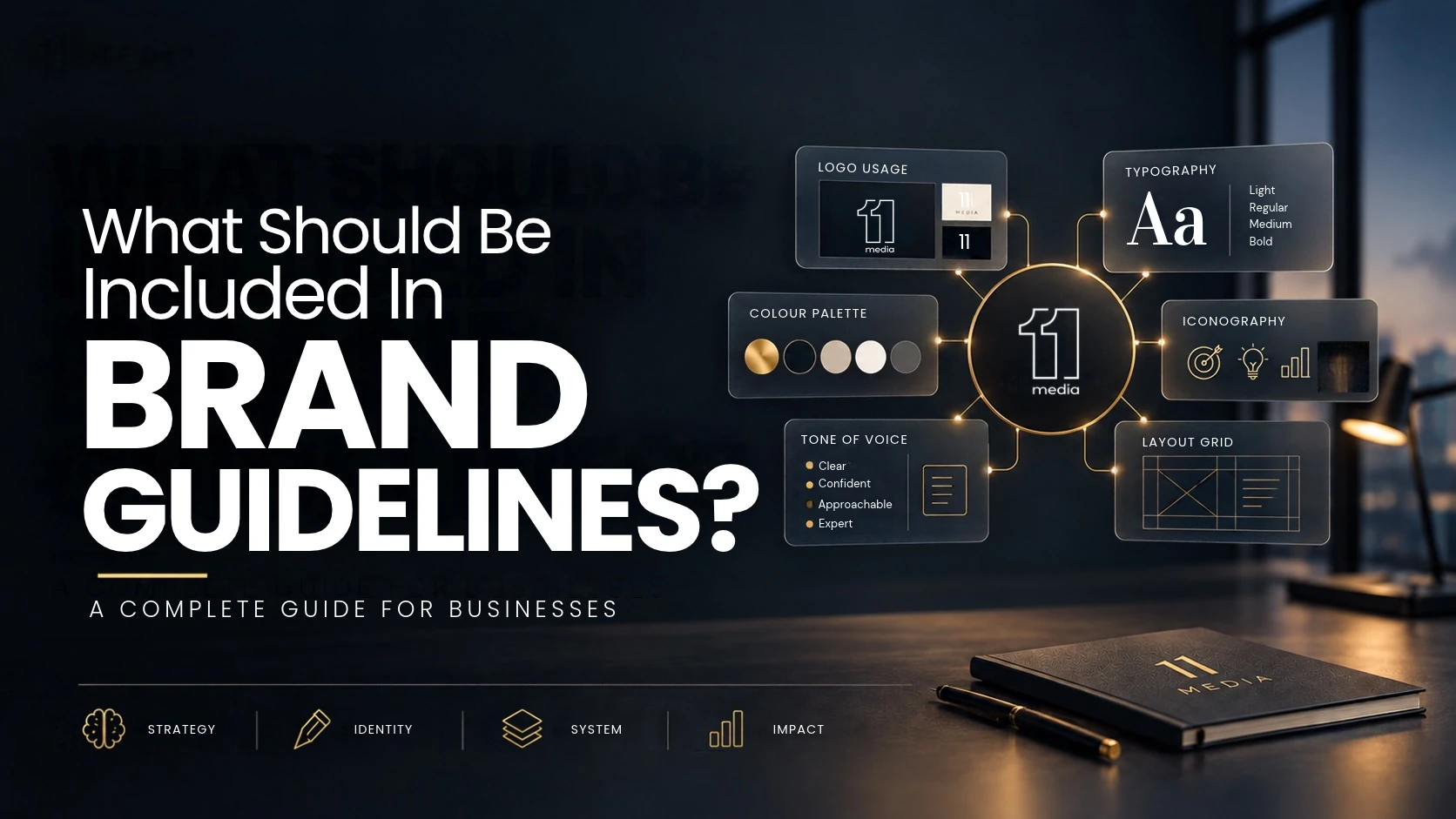
Include primary and secondary logos, horizontal and vertical variations, logo symbols, monochrome versions and light and dark variations.
Also define minimum logo size, clear space, approved backgrounds and incorrect usage.
Show examples of what not to do, such as stretching, rotating, recolouring or adding unnecessary effects to the logo.
3. Brand Colour Palette
Colours help customers recognise and associate themselves with your brand.
Your guidelines should identify primary and secondary colours, along with their exact specifications:
This prevents colour variations between your website, social media creatives and printed materials.
4. Typography
Typography influences how your brand looks and feels.
Define the approved fonts for headings, subheadings, body text and captions. Include font weights, sizes and spacing where necessary.
For most businesses, two or three complementary typefaces are enough. The important part is ensuring that your typography remains consistent across different platforms.
5. Brand Voice and Tone
A brand should have a recognisable personality, even when its logo isn’t visible.
Explain how your business communicates. Is it professional, friendly, conversational, bold, premium or educational?
Include examples of phrases that match your brand and language that doesn’t.
For example, a premium brand may use confident, refined language rather than exaggerated promotional statements.
6. Brand Messaging
Brand voice defines how you communicate, while brand messaging defines what you communicate.
This section should cover your brand story, tagline, value proposition, key messages, messaging pillars and product or service descriptions.
You can also include preferred words and phrases to use or avoid.
This helps your marketing, sales and customer service teams communicate the same core message.
7. Photography and Image Style
Images play a major role in shaping how customers perceive your business.
Define your preferred photography style, lighting, composition, backgrounds, image quality, editing approach and use of product or lifestyle photography.
Include visual references showing suitable and unsuitable images. Examples often make these instructions easier to understand.
8. Graphic Elements and Visual Assets
Your brand identity may include more than colours, fonts and logos.
It could also use specific patterns, icons, illustrations, shapes, textures, lines and decorative elements.
Explain how these assets should be used and how they should work alongside other brand elements.
This creates a visual language that people can recognise even without seeing your logo.
9. Social Media Guidelines
Social media is one of the most frequent places customers interact with a brand.
Your guidelines should establish rules for post layouts, colours, typography, logo placement, reels, stories, video styles, cover images and caption tone.
The objective isn’t to make every social media post identical. It’s to ensure that different content formats maintain a consistent brand identity.
10. Website and Digital Guidelines
Your website, landing pages, email campaigns and digital advertisements should follow the same visual identity.
Include guidelines for website buttons, colours, typography, icons, banners, email signatures and digital presentations.
This helps create a connected experience from the first online interaction to the final customer enquiry.
11. Print and Offline Applications
Your brand identity should work just as well in physical marketing materials as it does online.
Show how the identity should appear on business cards, brochures, catalogues, packaging, flyers, posters, letterheads, signage and product labels.
Pay attention to print specifications, colour reproduction and logo placement.
12. Brand Do’s and Don’ts
A simple do’s and don’ts section makes your guidelines easier to follow.
Do:
-
Use approved logo variations.
-
Follow the official colour palette.
-
Maintain correct logo spacing.
-
Use approved typefaces.
-
Follow the defined brand voice.
Don’t:
-
Stretch or distort the logo.
-
Change official brand colours.
-
Use random fonts.
-
Add unnecessary visual effects.
-
Use inconsistent imagery or messaging.
Showing visual examples of incorrect usage can prevent common branding mistakes.
13. Real-World Brand Applications
Finally, demonstrate how all the elements work together.
Include examples of social media designs, business cards, website layouts, brochures, packaging, advertisements and presentations.
These applications help employees, designers and marketing partners understand how to use the brand identity in everyday situations.