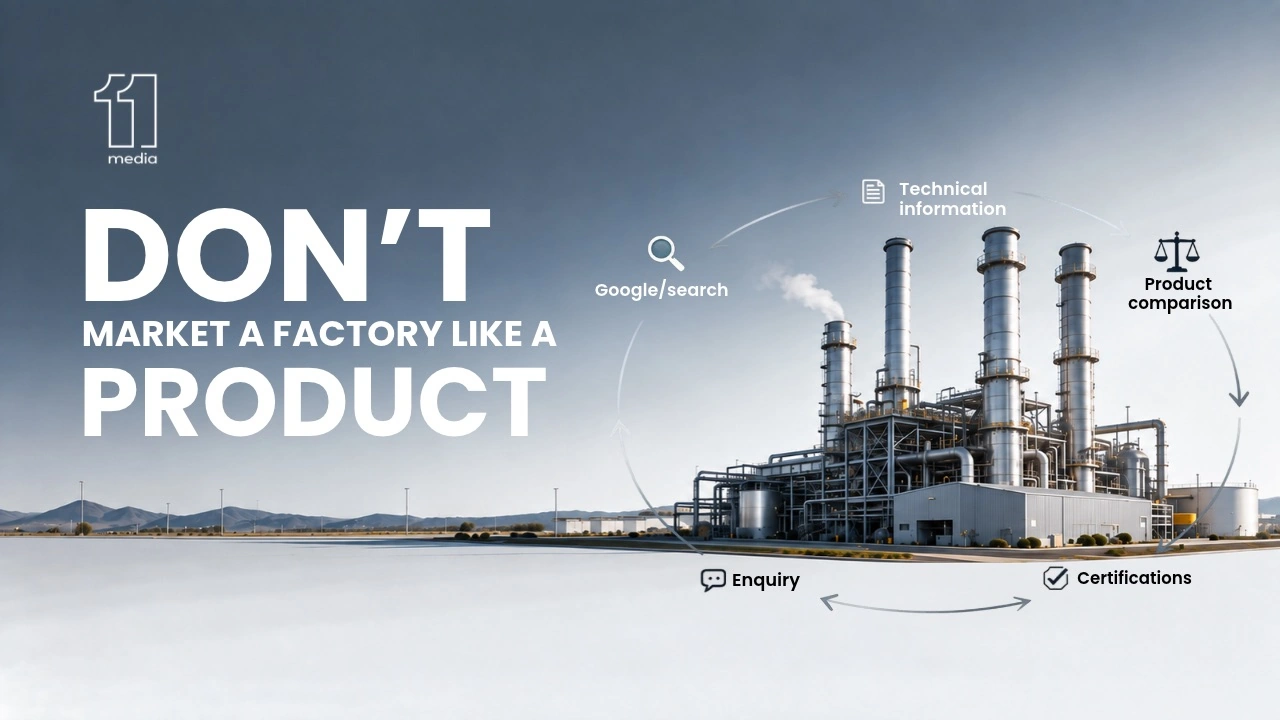
Manufacturers should not assume that potential customers will call simply because they need a product.
People research first.
They may search for:
-
Product categories
-
Technical specifications
-
Applications
-
Material comparisons
-
Manufacturers
-
Suppliers
-
Industry solutions
-
Product alternatives
-
Installation information
-
Quality standards
This makes B2B SEO an important part of a manufacturing digital marketing strategy.
Instead of creating content around only the company name and product names, manufacturers should understand what their potential buyers actually search for.
4. SEO for Manufacturers Should Cover the Entire Buying Journey
A manufacturer can target different types of search intent.
Informational searches
People are trying to understand something.
Examples:
Commercial searches
People are comparing options.
Examples:
-
Porcelain pavers vs concrete pavers
-
Best material for outdoor flooring
-
Types of industrial packaging
Supplier searches
People are looking for companies.
Examples:
-
Porcelain paver manufacturer
-
Ceramic tile manufacturer
-
Industrial component supplier
Product-specific searches
People already know what they need.
Examples:
-
20mm outdoor porcelain pavers
-
Large format ceramic tiles
-
Industrial metal components
A strong SEO strategy for manufacturers should address all of these stages.
5. Technical Content Can Become a Marketing Advantage
Manufacturers often have a huge amount of technical knowledge inside the company.
The problem is that much of it stays with the sales or engineering team.
That knowledge can become valuable marketing content.
For example:
A sales team might repeatedly answer:
“What is the difference between these two product finishes?”
That’s not just a sales question.
It could become:
-
A blog article
-
Product comparison
-
FAQ
-
LinkedIn post
-
Product video
-
Sales presentation
-
Website section
In other words, sales conversations can become content ideas.
This creates content that addresses real buyer questions rather than generic marketing topics.
6. LinkedIn Matters Differently for Manufacturers
For many manufacturers, LinkedIn can be more than another social media platform.
It can become a place to demonstrate:
-
Manufacturing expertise
-
Product innovation
-
Factory capabilities
-
Industry knowledge
-
New product launches
-
Certifications
-
Projects
-
Export capabilities
-
Company developments
-
Team expertise
Instead of constantly posting:
“Our product is the best.”
manufacturers can share useful insights.
For example:
“What should architects consider when choosing an outdoor surface?”
or
“Three factors that affect the durability of industrial components.”
This type of content can start conversations with the people who actually influence B2B purchasing decisions.
7. Show the Manufacturing Process
Manufacturing is naturally visual.
Factories, machinery, production lines, quality checks, raw materials and finished products can all become content.
Use:
This gives potential buyers something that a simple product photograph cannot:
proof of capability.
For manufacturers competing internationally, showing the process can also help establish credibility with buyers who have never visited the facility.
8. 3D Visualization Can Make Complex Products Easier to Market
Some manufacturing products are difficult to photograph or explain.
3D visualisation and CGI can help demonstrate:
-
Product structure
-
Product applications
-
Different configurations
-
Materials
-
Finishes
-
Installation
-
Internal components
-
Product functionality
A single 3D model can also be adapted into website visuals, product videos, catalogues, social media content and sales presentations.
This makes 3D visualisation for manufacturers a useful part of a broader content strategy.
9. Manufacturing Websites Need Stronger Lead Generation
A manufacturer’s website should not simply act as an online company brochure.
It should help generate enquiries.
Clear calls to action can include:
The right CTA depends on the product and buying process.
A potential buyer who isn’t ready to request a quote may still be willing to download a catalogue.
That’s why manufacturers should provide different conversion points for different stages of the buying journey.
10. Content Should Support AEO and GEO Too
Traditional SEO is only one part of modern search visibility.
Manufacturers should also think about AEO (Answer Engine Optimization) and GEO (Generative Engine Optimization).
AEO
AEO focuses on creating content that clearly answers questions.
For example:
What is the difference between porcelain and ceramic tiles?
A manufacturer can provide a concise answer followed by a detailed explanation.
FAQs, comparison content, definitions and structured product information can make technical content easier to understand.
GEO
GEO focuses on making a brand and its information easier for generative AI systems to understand and potentially reference.
Manufacturers can support this by maintaining consistent information across:
-
Website
-
Product pages
-
Digital catalogues
-
Business profiles
-
Industry directories
-
LinkedIn
-
Third-party publications
The important thing is consistency.
If product specifications, company information and capabilities differ across different platforms, it becomes harder to build a clear digital presence.
11. International Manufacturers Need International SEO
Many manufacturers don’t sell only in their home market.
They may target:
-
United States
-
Australia
-
UAE
-
Qatar
-
Europe
-
Asia
-
Other export markets
A generic global website may not be enough.
International SEO can involve:
-
Country-specific landing pages
-
Localised keywords
-
Market-specific content
-
Product terminology used in each market
-
Shipping/export information
-
Relevant case studies
-
Local search intent
For example, the terminology used by an architect in Australia may differ from that used by a buyer in the Middle East.
Good international marketing recognises those differences.
12. Trust Signals Matter More in B2B Manufacturing
A potential buyer may be taking a significant commercial risk when choosing a supplier.
They want evidence.
Your website should make relevant proof easy to find:
-
Certifications
-
Years of experience
-
Production capacity
-
Quality processes
-
Export markets
-
Client projects
-
Case studies
-
Testimonials
-
Product testing
-
Industry memberships
-
Factory information
Don’t simply claim that your company provides “high quality.”
Show the evidence behind the claim.
13. Don’t Separate Sales and Marketing
Manufacturing marketing works best when sales and marketing share information.
Sales teams know:
-
What customers ask
-
Why deals are lost
-
Which products get the most enquiries
-
What objections buyers have
-
Which competitors appear in conversations
Marketing teams can turn that information into:
-
FAQs
-
Blog articles
-
Comparison pages
-
Videos
-
Case studies
-
Product guides
-
LinkedIn content
-
Website improvements
This creates a much more useful content strategy.
14. Measure Leads, Not Just Likes
A manufacturing company’s marketing performance shouldn’t be judged only by social media engagement.
More useful metrics may include:
A post receiving 500 likes isn’t necessarily more valuable than a technical article that generates several qualified enquiries.
Marketing should ultimately connect visibility with business outcomes.
Final Thoughts
Manufacturing marketing is different because the buying journey is different.
Customers may need technical information, comparisons, proof of quality, application examples and direct access to experts before they are ready to buy.
That’s why manufacturers need more than a social media calendar or a basic company website.
They need a digital marketing for manufacturers strategy built around the way their buyers research, compare and make decisions.
That strategy can bring together:
SEO + B2B content + LinkedIn + product marketing + 3D visualisation + website optimisation + AEO + GEO + lead generation.
The goal isn’t to create more marketing content simply for the sake of being visible.
The goal is to make it easier for the right buyer to discover the manufacturer, understand the product, trust the company and take the next step.
For manufacturers, digital marketing isn’t just about being seen. It’s about being understood and being considered when the buying decision is made.
At 11 Media Branding & Marketing Agency, manufacturing brands can bring branding, content, 3D/CGI visualisation, website development, SEO, social media and digital marketing together into a more connected digital presence.