The term branding agency refers to a specialised firm that helps businesses define, build, and manage their brand identity. In simple terms, a branding agency meaning goes beyond logo design — it covers brand strategy, positioning, messaging, visual identity, and how a business is consistently perceived across every customer touchpoint. When people search for what a branding company does, they are usually asking how an agency turns a business idea into a recognisable, trusted brand. That is exactly what a branding agency is built to do.
What a Branding Agency Actually Does — Step by Step
Step 1 — Discovery and Research
Every serious branding project starts with research. Before any creative work begins, a branding agency needs to deeply understand your business, your market, and your audience.
This typically includes:
Business discovery — Understanding your history, your goals, your products or services, your team, and what makes your business work.
Market research — Analysing the category you operate in, the trends shaping it, and the opportunities available to you.
Competitor analysis — Studying your direct and indirect competitors — their positioning, visual identity, messaging, and brand strengths and weaknesses.
Audience research — Understanding who your ideal customers are, what they value, how they make decisions, and what they respond to.
This research phase is what separates strategic branding from superficial design. Without it, creative decisions are guesswork.
Step 2 — Brand Strategy
Once research is complete, a branding agency develops your brand strategy. This is the most important — and most undervalued — part of the entire process.
Brand strategy defines:
Brand positioning — The specific space your brand occupies in the market relative to competitors. What you stand for, who you serve, and what makes you the right choice over alternatives.
Brand purpose and values — Why your business exists beyond making money, and the principles that guide how it operates.
Target audience definition — A precise description of who your ideal customer is — demographics, psychographics, behaviours, and motivations.
Brand personality — The human characteristics your brand embodies. Is it bold or gentle? Playful or serious? Premium or accessible? This personality shapes every piece of communication.
Key messages — The core things your brand communicates consistently across all touchpoints.
Brand strategy is the foundation everything else is built on. A logo designed without a strategy is just a shape. A logo designed with a clear strategy communicates something specific to a specific audience — and that is the difference between branding that works and branding that decorates.
Step 3 — Visual Identity Design
This is the part most people think of when they hear “branding agency” — and it is where strategy becomes visible.
A complete visual identity includes:
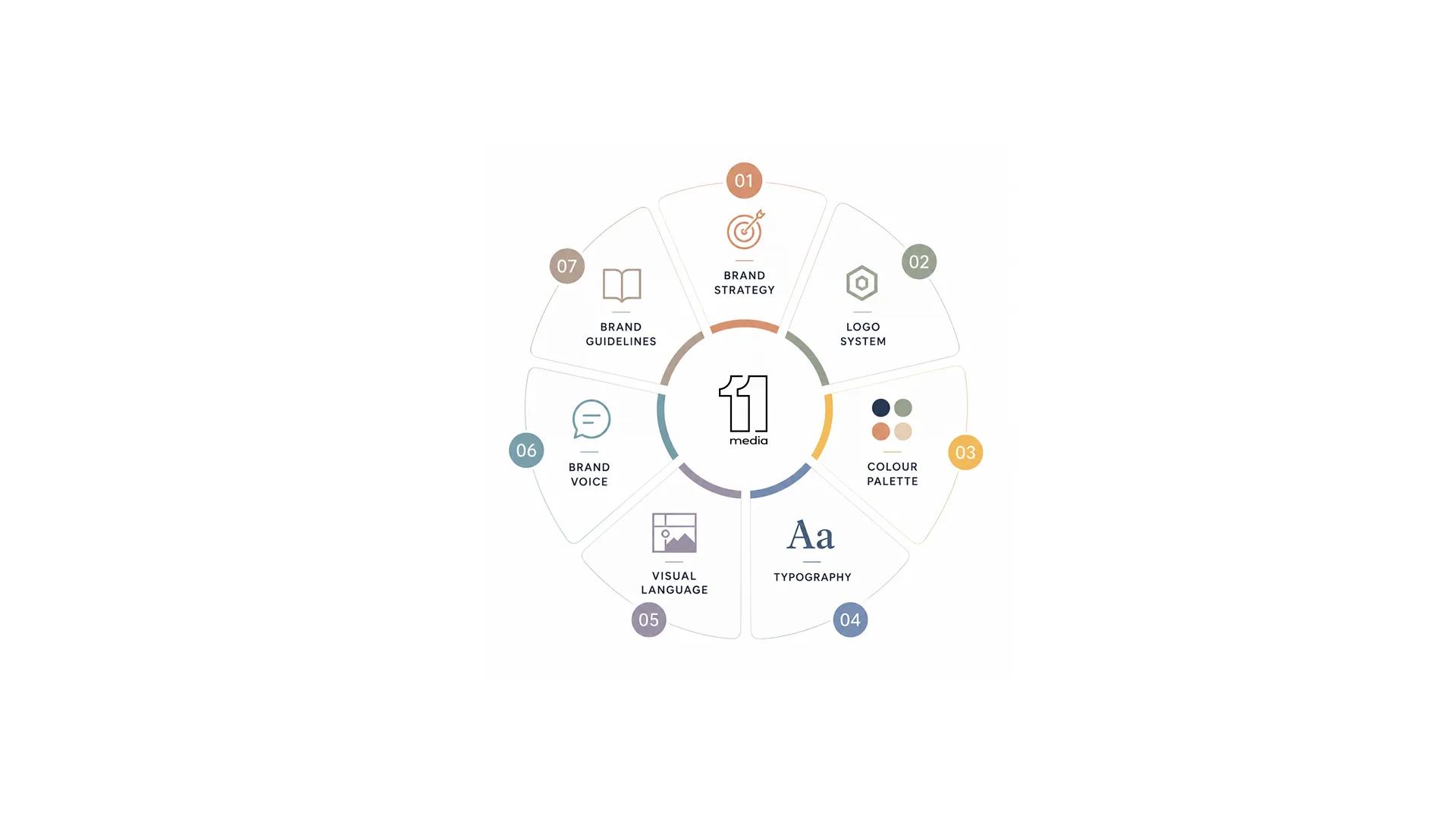
Logo system — Not just one logo, but a family of logo variations — primary, secondary, icon-only — built to work across different applications and
sizes.
Colour palette — A defined set of brand colours with exact codes for digital (HEX, RGB) and print (CMYK, Pantone). Colour is one of the most powerful brand recognition tools — research shows colour increases brand recognition by up to 80%.
Typography — The typefaces your brand uses and the rules for how they are applied — headings, body text, captions, and combinations.
Visual language — The overall graphic style of your brand — patterns, textures, illustration styles, photography direction, icon style — the elements that make your brand visually recognisable even without a logo.
Brand collateral — The application of your identity to real-world materials — business cards, letterheads, packaging, signage, presentations, and more.
Step 4 — Brand Messaging and Voice
Visual identity tells people how a brand looks. Brand messaging and voice tell people how a brand speaks.
This includes:
Tagline or brand line — A short, memorable phrase that captures your brand’s essence.
Brand story — A compelling narrative about your business — where you came from, what you believe, and why it matters.
Tone of voice — The personality and style of your written communication. Formal or conversational? Technical or simple? Warm or authoritative?
Key messages — The specific claims and benefits your brand communicates consistently — to customers, to partners, to the media.
Messaging consistency is what makes brands memorable. When your brand sounds the same on your website, your Instagram, your brochure, and your pitch deck — people start to trust it.
Step 5 — Brand Guidelines
Everything developed in the previous steps is compiled into a brand guidelines document — often called a brand bible or brand book.
This document is the rulebook for your brand. It covers:
How to use the logo correctly and incorrectly
Approved colour combinations
Typography rules
Photography and visual style guidance
Tone of voice examples
Do’s and don’ts for brand application
Brand guidelines ensure consistency — whether it is your internal team creating content, a printer producing packaging, or a new agency running your campaigns. Everyone works from the same rules.
Step 6 — Digital Presence and Rollout
Many branding agencies — including 11 Media — also handle the rollout of your new brand across digital platforms.
This includes:
Website design and development — Translating your brand identity into a fully functional, SEO-optimised website that reflects your positioning and
converts visitors into customers.
Social media setup — Setting up or refreshing your social media profiles with consistent branding across all platforms.
Content strategy — Planning how your brand will show up consistently through content — what to post, how often, in what format, and with what voice.
Campaign launch — Some agencies support the launch of your new brand with a campaign — social media content, paid advertising, PR, or influencer outreach.
Step 7 — Ongoing Brand Management
The best branding agencies don’t disappear after delivery. They stay involved as ongoing brand partners — helping you apply your brand correctly as your business grows, evolves, and enters new markets.
This might include:
– Periodic brand audits
– New campaign creative
– Brand extension into new product lines
– Adapting the brand for new markets or audiences