**Imagine showcasing your product in a sleek studio setting, on a marble countertop, floating mid-air with cinematic lighting — without booking a single photoshoot. No studio rent. No logistics. No retakes. Just a photorealistic image that looks better than most professional photography. That’s exactly what 3D product visualisation delivers — and the brands using it in India right now are converting more, spending less, and scaling faster than those still relying on traditional shoots.**
Your customer can’t touch the product.
They can’t smell it, feel the weight of it, or test it in person.
All they have is what they see on screen.
And if what they see on screen doesn’t impress them in two seconds —
they scroll past. They buy from someone else.
This is the fundamental challenge of selling online.
And it’s exactly why 3D product visualisation in India is no longer just for large brands with Hollywood-sized budgets.
It’s become the most powerful visual tool available to any product business — at any size.
3D product visualisation — also called CGI product rendering — is the process of creating photorealistic images or animations of a product using computer graphics software.
Instead of arranging physical props, booking a studio, and spending days on a traditional photoshoot —
a 3D artist builds a digital model of the product and renders it in any environment, any angle, any lighting condition imaginable.
The result looks identical to a high-end product photograph.
Sometimes better.
– Perfect lighting — every time
– Impossible camera angles that no lens could physically achieve
– Product shown in settings that don’t exist yet
– Infinite colour and variant options — without manufacturing a single unit
– No packaging damage, no props, no weather delays
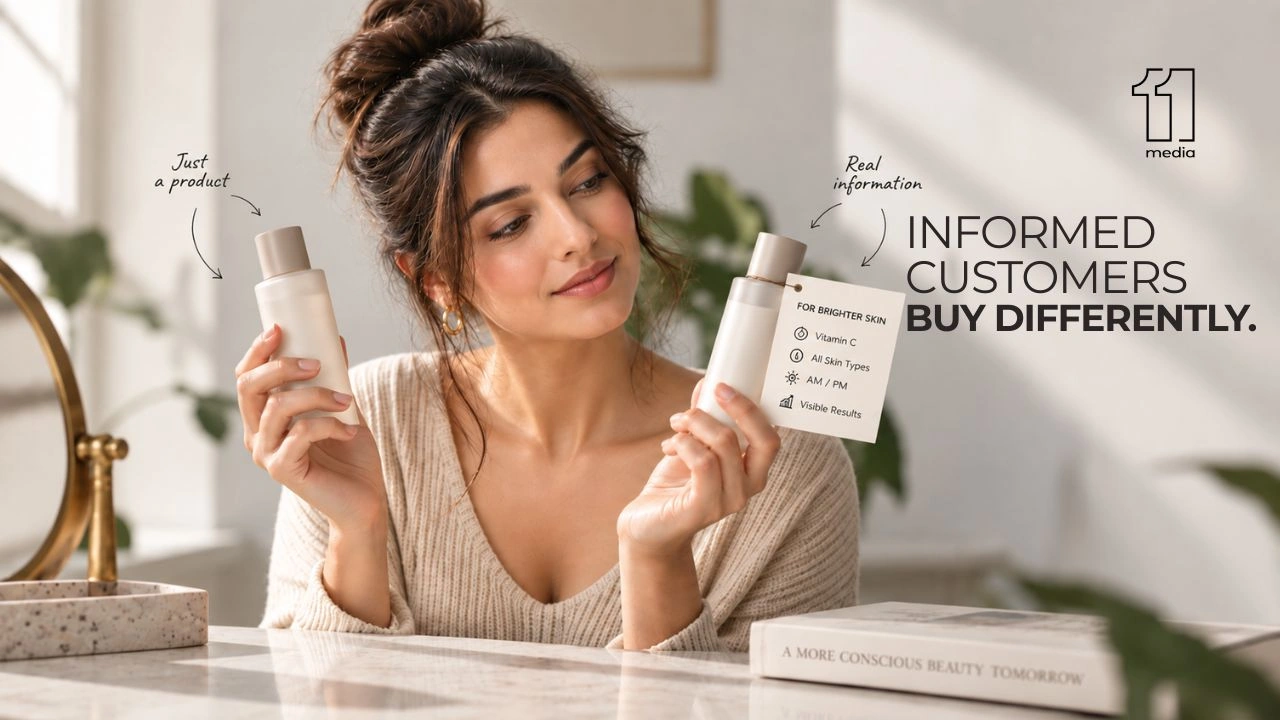
3D product visualisation bridges the gap between physical retail and online shopping — giving customers the confidence they need to buy without ever touching the product.
The data on 3D visualisation and e-commerce is not subtle.
Retailers using 3D content see a 94% average conversion lift on Shopify.
Interactive 3D tools and AR increase purchase intent by 64% compared to standard product photography.
63% of customers say AR and 3D experiences would improve their shopping journey — and 70% say they’d be more loyal to brands that offer them.
And for the Indian market specifically:
The Asia-Pacific region is projected to grow at 18.1% CAGR in the 3D rendering market — the fastest of any region globally.
India’s 3D rendering market is expanding rapidlyz, driven by e-commerce growth, digital content demand, and a surge in brands competing for attention on Instagram, Flipkart, Amazon, and Meesho.
The brands adopting 3D product visualisation in India today are building a visual advantage that traditional photography simply cannot match.
India’s e-commerce market is projected to cross ₹54 lakh crore by 2034.
Every major platform — Amazon India, Flipkart, Myntra, Nykaa, Meesho — is becoming more competitive by the month.
In that environment, your product image is your first salesperson.
But traditional product photography has real limits for Indian businesses:
– High cost per shoot — especially for multiple SKUs and colour variants
– Long turnaround — booking studios, logistics, retouching
– Inconsistency across product lines
– Impossible to show products in aspirational lifestyle contexts affordably
– New variants require entirely new shoots
3D product rendering for e-commerce in India solves all of these problems simultaneously.
One 3D model. Infinite outputs.
Change the colour — render it. Change the background — render it.
Show it floating in space, on a marble counter, inside a lifestyle scene — all from the same base model.
For Indian D2C brands, manufacturers, and exporters — this is a fundamental shift in how visual content gets created and scaled.
The short answer: any business that sells a physical product.
But here’s where it delivers the most impact:
**D2C and e-commerce brands** — fashion, beauty, home décor, electronics, wellness, food packaging. Any brand competing on product pages where visuals directly influence the buy button.
**Manufacturers and exporters** — ceramic and tile companies, furniture producers, industrial equipment brands. Showing international buyers hyper-realistic renders of products before they’re even manufactured saves time, builds confidence, and wins deals.
**Real estate and architecture** — visualising spaces, furniture layouts, and interiors before construction. Buyers make emotional decisions based on renders.
**Jewellery and luxury goods** — where surface detail, reflection, and material quality are everything. CGI renders outperform standard photography for high-value items by showing craftsmanship at a level cameras struggle to capture.
**Startups launching new products** — visualising a product before the final manufacturing run allows for design iterations without physical cost.
Both have their place. But the comparison is shifting fast.
| | Traditional Photography | 3D Product Visualisation |
|—|—|—|
| Cost per variant | High — new shoot each time | Low — single model, infinite outputs |
| Turnaround | Days to weeks | 2–5 days per scene |
| Colour/variant changes | New photoshoot required | Change in software — render again |
| Impossible angles | Limited by physics | Unlimited |
| Lifestyle scenes | Expensive to set up | Built digitally — no limits |
| Consistency | Variable | Perfect every time |
| Scalability | Low | Very high |
For brands with more than 5 product SKUs or regular new launches —
3D product visualisation becomes more cost-effective than traditional photography within the first few projects.
At ELVN Media, 3D product visualisation is one of our core capabilities — and one of the most powerful services we bring to product brands in India.
Our 3D and CGI team doesn’t just build models.
We understand brand identity, visual storytelling, and what makes a product image stop a scroll and start a conversation.
Our 3D product visualisation process covers:
– Product brief and reference gathering
– 3D modelling from physical product or design files
– Material, texture, and surface detailing
– Lighting and environment design
– Rendering in multiple angles and contexts
– Post-production and brand colour alignment
– Final delivery in all formats — web, social, print, export catalogue
Whether you’re a D2C brand launching on Instagram, a manufacturer creating an export catalogue, or a startup visualising a product before it’s built —
we deliver renders that look better than most product photographs.
Because in 2026, the brands winning online aren’t just the ones with the best products.
They’re the ones with the best visuals.
Let’s make your product impossible to scroll past.
Let’s rethink how your brand shows up online.
It’s more accessible than most people assume — and more cost-effective than traditional photography for any brand with multiple products.
A single high-quality 3D product render typically costs less than a full professional photoshoot.
And unlike a photoshoot, the same 3D model can be reused infinitely — new angles, new backgrounds, new colour variants — without additional shooting costs.
For a brand launching with 10 SKUs, the math almost always favours 3D.
The cost of 3D modelling software and services has been decreasing steadily, making this technology accessible to businesses well beyond enterprise level.
At ELVN Media, we scope every 3D project based on your product complexity and output requirements — so you only pay for what your brand actually needs.
For a single hero product render — typically 3–5 working days from brief to delivery.
For a full product line with multiple scenes and variants — 2–3 weeks depending on complexity.
The process follows these stages:
1. Brief and reference collection — 1 day
2. 3D modelling and texturing — 2–4 days
3. Scene setup, lighting, and rendering — 1–2 days
4. Review, revisions, and final delivery — 1–2 days
Compared to scheduling a studio, managing logistics, shooting, and retouching —
3D visualisation is often faster than traditional photography and produces consistent, repeatable results.
Yes — and this is one of the biggest advantages.
A 3D render is delivered as a high-resolution image file that works across every platform and format:
– Instagram and Reels (square, portrait, landscape)
– Amazon, Flipkart, Meesho product listing images
– Website hero banners and product pages
– Export catalogues and printed brochures
– WhatsApp product showcases
– YouTube thumbnails and ad creatives
Because the render is created at the highest possible resolution, it can be scaled and cropped for any use case without quality loss.
One product. One 3D model. Used everywhere — consistently.
That’s the power of 3D product visualisation for Indian brands.